All products are handled with strict quality standards to ensure consistent research-grade excellence.
Our checkout is SSL encrypted and completely secure.
Our products are verified by independent third party laboratories to meet quality standards.
All product batches and lots are assigned unique identifiers and tied to publicly posted lab reports.
We are committed to helping our customers. If you have any questions or concerns, please reach out through our Contact Us page.
$130.00 Original price was: $130.00.$104.99Current price is: $104.99.
| Quantity | Discount | Price |
|---|---|---|
| 5 - 10 | 5% | $99.74 |
| 11 - 20 | 10% | $94.49 |
| 21+ | 15% | $89.24 |
Every batch of our research chemicals and peptides undergoes third-party testing.
*Disclaimer: This product is intended solely for laboratory research purposes. It is not suitable for consumption by humans, nor for medical, veterinary, or household purposes. Kindly review our Terms & Conditions before making a purchase.
Always quality-tested, verified with third party COA’s
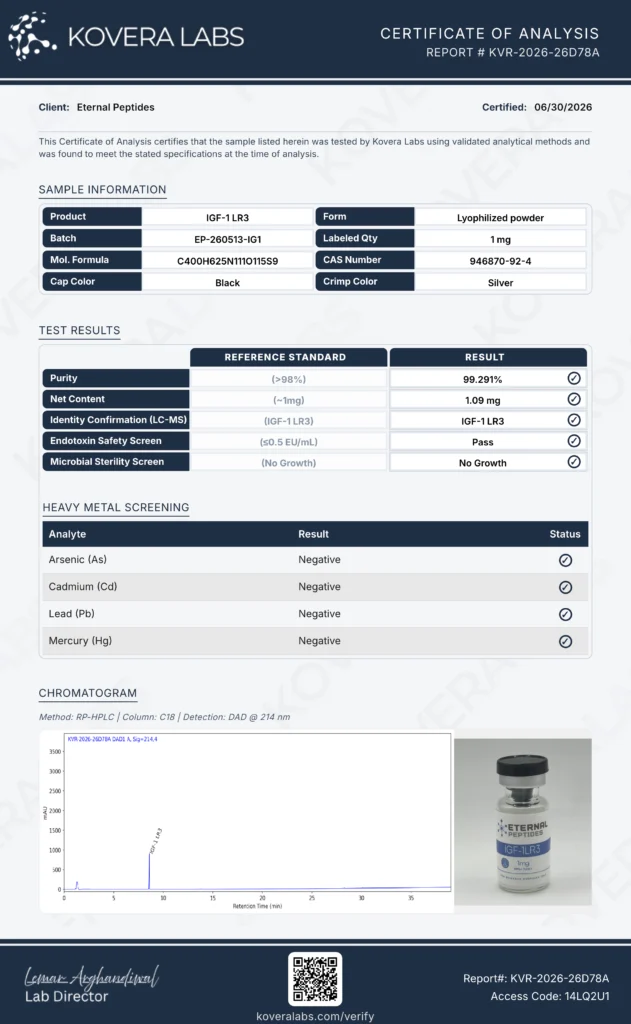
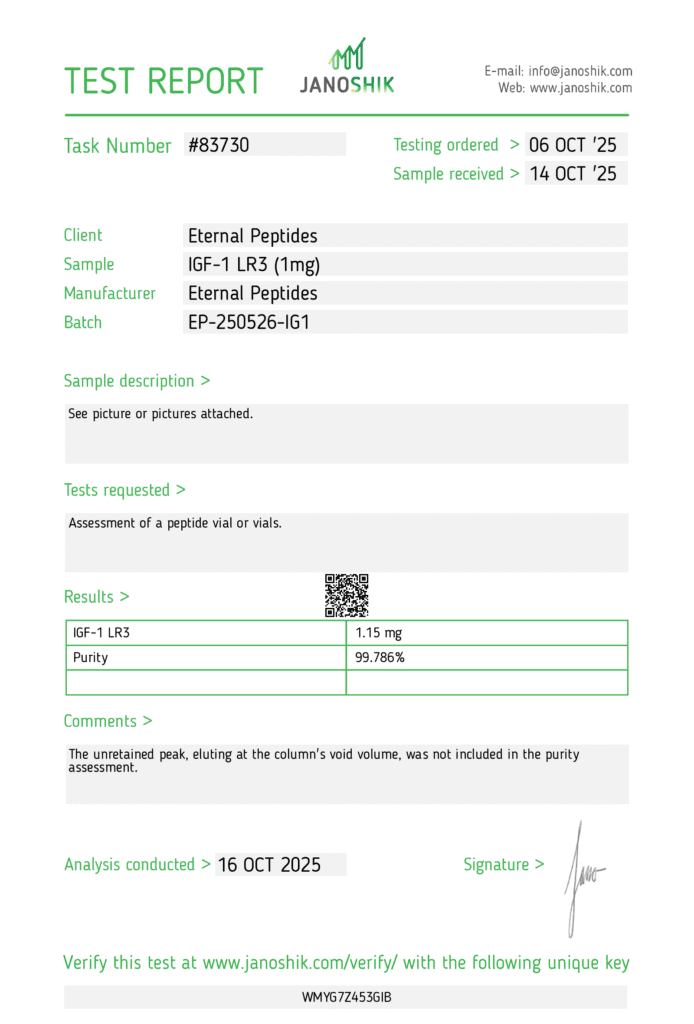
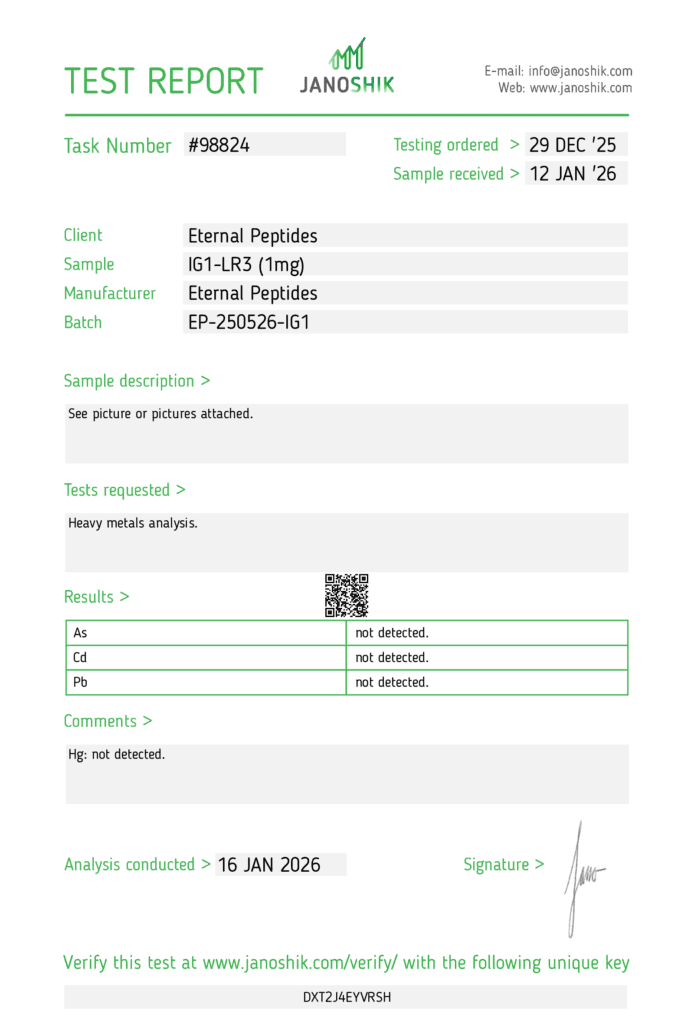
At every step, we prioritize quality by conducting rigorous third-party testing on all our products. These tests focus on five key characteristics- identity, purity, sterility, and endotoxin levels, and heavy metal content-ensuring that each product meets the highest standards of quality with independent third-party Certificates of Analysis (COAS) to verify our commitment to excellence.
*Disclaimer: This product is intended solely for laboratory research purposes. It is not suitable for consumption by humans, nor for medical, veterinary, or household purposes.Kindly review our Terms & Conditions before making a purchase.
Shop IGF-1 LR3 1mg from Eternal Peptides, a trusted supplier of research compounds with rigorous independent quality verification across every batch. IGF-1 LR3 is a long-acting recombinant analogue of insulin-like growth factor-1 studied in laboratory models of cellular growth, differentiation, and metabolic signaling. Each 1mg lyophilized unit is independently tested for 99%+ purity and identity by third-party labs, with Certificates of Analysis available for full transparency. Competitively priced with fast, secure USPS shipping free on orders over $200. Sold for research use only.
IGF-1 LR3 (Insulin-Like Growth Factor-1 Long R3) is a synthetic, recombinant analog of human insulin-like growth factor-1 (IGF-1), engineered to have altered binding characteristics and extended activity in experimental systems[1]. It consists of 83 amino acids, compared to the 70 amino acids of mature native IGF-1, and carries two deliberate structural modifications: a glutamic acid-to-arginine substitution at position 3 of the native sequence, and the addition of a 13-amino acid extension peptide (MFPAMPLLSLFVN) at the N-terminus.
These changes were introduced specifically to reduce the molecule’s affinity for IGF-binding proteins (IGFBPs), the family of six principal serum proteins that normally sequester free IGF-1 and limit its bioavailability. The arginine substitution at position 3 is particularly significant in this regard, as this region of the native molecule is a known contact point for IGFBP binding.
In cell culture systems, IGF-1 LR3 has been reported to have approximately 2–3 times greater potency than native IGF-1 in receptor activation assays, largely attributed to this reduced IGFBP sequestration rather than intrinsically higher receptor affinity[2]. In solution-based binding assays, its affinity for the IGF-1 receptor (IGF-1R) is actually modestly lower than that of native IGF-1.
The analog was developed in the early 1990s, primarily through work conducted at GroPep Ltd. (Australia) and affiliated academic groups, as a pharmacological tool to study IGF-1R-mediated signaling with more experimentally controllable pharmacokinetics. Its reported half-life in animal serum ranges from roughly 20 to 30 hours, compared to the minutes-to-hours range typical of free native IGF-1 in the same systems, though these figures vary considerably by species, route of administration, and assay method.
It should be noted that rigorous pharmacokinetic data in humans for this specific analog are not established in the peer-reviewed literature. As such, the observations below should not be taken to extend to human or therapeutic applications, and any inference beyond the experimental systems in which they were obtained would exceed what the current evidence base supports.
IGF-1 LR3 is a modified IGF-1 analog that primarily acts by activating the IGF-1 receptor (IGF-1R) and sustaining downstream growth and metabolic signaling. A second key theme is reduced binding to IGF-binding proteins (IGFBPs), which increases the fraction available to interact with receptors in experimental systems and extends functional exposure relative to native IGF-1.
In cell and animal models, these mechanisms are used to study proliferation, differentiation, protein synthesis signaling, and survival responses, most commonly in skeletal muscle, metabolic, and bioprocessing contexts described in widely cited IGF-system literature and serum-free culture studies.
When IGF-1 LR3 binds to IGF-1R, the receptor activates by phosphorylating itself at specific intracellular sites, which creates docking points for adaptor proteins, principally IRS-1 and Shc, that relay the signal into the cell[3]. From there, two major signaling branches are engaged.
The first, the PI3K–Akt–mTOR pathway, is primarily associated with protein synthesis and cell survival. Activation of this branch is commonly measured in research by tracking phosphorylation of downstream markers S6K1 and 4E-BP1, which serve as indicators of a cell’s translational activity, essentially monitoring how actively it is building new proteins.
The second, the MAPK/ERK pathway, is more closely linked to cell proliferation. It influences the progression of cells through the division cycle, in part by upregulating cyclin D1, a protein that helps drive cells from a resting state into active division. These two branches are not entirely separate; instead, they interact and influence each other, and the balance between them shifts depending on cell type and signaling context.
In practice, laboratory studies track activation of these pathways using phosphorylation assays, cell cycle analysis, and apoptosis markers under controlled conditions. It is also worth noting that IGF-1 LR3 retains modest affinity for the insulin receptor, a consequence of the structural similarity shared across the insulin/IGF peptide family, though its preference for IGF-1R is sufficient for most research applications focused on IGF-specific signaling.
In the body and in serum-containing laboratory media, native IGF-1 spends most of its time bound to a family of carrier proteins called IGF-binding proteins (IGFBPs)[4]. While these proteins serve important regulatory roles, they also limit how much IGF-1 is freely available to interact with receptors at any given time. Two members of this family (IGFBP-3 and IGFBP-5) account for the majority of this sequestration under normal conditions.
One of the structural modifications in IGF-1 LR3, the amino acid substitution at position 3, directly disrupts a region of the molecule that IGFBPs use to bind it. The result is that a greater proportion of IGF-1 LR3 remains in a receptor-accessible form compared to native IGF-1 at equivalent concentrations, which is a meaningful practical advantage in experimental settings where IGFBPs would otherwise neutralize a substantial fraction of the added peptide.
This property is part of why IGF-1 LR3 is commonly used as a supplement in serum-free or low-serum cell culture systems, particularly in biopharmaceutical manufacturing, where studies have reported improvements in cell viability, proliferation, and recombinant protein output in certain cell lines relative to insulin or native IGF-1.
The same mechanism is thought to underlie the extended functional half-life observed in animal models, estimated at roughly 20–30 hours compared to the much shorter window typical of free native IGF-1. However, these figures vary by species and experimental conditions.
Mechanistic understanding of IGF-1 LR3 is driven largely by cell-based assays and rodent studies conducted under controlled experimental conditions. The specific signaling outcomes, potency relationships, and pharmacokinetic parameters described above reflect those preclinical systems and should not be assumed to translate directly to human physiology, where differences in IGFBP profiles, receptor density, tissue-specific expression, and endocrine feedback regulation may substantially alter the biological response.
Controlled human clinical evidence for this specific analog is not established in the peer-reviewed literature, and all findings should be interpreted strictly within the preclinical research context in which they were obtained.
Preclinical research has examined IGF-1 LR3 in areas such as skeletal muscle biology, tissue regeneration models, metabolic signaling, and cell culture optimization. These observations are derived primarily from in vitro experiments and animal studies. They do not establish human or veterinary benefits, and IGF-1 LR3 is not approved for therapeutic use.
Eternal Peptides supplies this compound strictly for laboratory research and does not promote or imply clinical or human applications.
IGF-1 LR3 is frequently used in muscle cell culture and rodent studies investigating hypertrophy and anabolic signaling[5]. By activating IGF-1R and downstream PI3K/Akt/mTOR pathways, it increases markers associated with protein synthesis and myoblast differentiation in controlled settings. Animal models have shown changes in muscle fiber size and growth-related signaling when exposed under experimental conditions.
In short, researchers use IGF-1 LR3 to study how growth signals influence muscle cell development and protein production in laboratory systems.
IGF signaling plays a documented role in cell proliferation and survival, and IGF-1 LR3 has been explored in models of tissue regeneration, including muscle injury and nerve repair paradigms in animals[6]. Experimental findings often describe enhanced cellular proliferation, satellite cell activation, or improved survival signaling in damaged tissue models.
In other words, scientists use IGF-1 LR3 to observe how enhanced IGF-1 receptor activity affects repair-related cellular responses in animal studies.
In rodent research, IGF pathway activation has been associated with altered glucose uptake and insulin sensitivity markers. IGF-1 LR3 has been used to examine how sustained IGF-1 receptor activation influences metabolic pathways, including Akt-mediated glucose transport mechanisms in muscle and other tissues[7]. These effects vary depending on dosing strategy and experimental design.
This means IGF-1 LR3 is used to study how growth-factor signaling interacts with metabolism in controlled laboratory animals.
Due to reduced binding to IGF-binding proteins and extended functional activity in vitro, IGF-1 LR3 has been incorporated into serum-free and low-serum culture systems. Studies report improved cell viability, proliferation, and productivity in certain mammalian cell lines compared to insulin-only supplementation[1].
In practical laboratory research, researchers use IGF-1 LR3 to help support growth and stability of cultured cells under defined experimental conditions.
Most available data on IGF-1 LR3 comes from cell-based assays and animal models. Controlled human clinical evidence for IGF-1 LR3 itself is limited, and these findings should be interpreted strictly within a preclinical research framework.
| Property | Description |
| Name | Insulin-Like Growth Factor-1 Long R3 (IGF-1 LR3); recombinant 83–amino acid analog of human IGF-1 with Arg substitution at position 3 and N-terminal 13–amino acid extension |
| Sequence | MFPAMPLLSLFVNPSRGVDEPSFYFNKPTGYGSSSRRAPQTGIVDECCFRSCDLRRLEMYCAPLKPAKSA |
| Molecular Weight | 9,117.5 g/mol |
| Molecular Formula | C400H625N111O116S9 |
| PubChem CID | n/a (CAS: 946870-92-4) |
| Structural Class | Recombinant growth factor analog; IGF family peptide hormone derivative |
| Product Form | Lyophilized powder supplied in 1 mg research vials |
| Purity | Typically ≥99%, verified via lot-specific Certificate of Analysis (COA) |
| Solubility | Soluble in sterile laboratory-grade water or dilute acetic acid after reconstitution; gentle mixing recommended |
| Stability | Stable in lyophilized form under refrigerated or frozen storage; reconstituted solutions require cold storage and minimized freeze–thaw cycles |
Note: IGF-1 LR3’s structural modifications reduce binding to IGF-binding proteins (IGFBPs), extending functional activity in experimental systems. It is supplied in lyophilized format to support stability during storage and transport and is designated strictly for research use only.
Proper handling of IGF-1 LR3 is essential to maintain structural integrity and ensure reproducible laboratory results. As a recombinant growth factor analog supplied in lyophilized form, it should be stored and reconstituted under controlled research conditions.
Each lot of IGF-1 LR3 is supported by a lot-specific Certificate of Analysis (COA) to ensure transparency, traceability, and research reproducibility. Eternal Peptides works with independent third-party analytical laboratories, including Janoshik, to provide objective verification of identity and purity standards.
COAs are generated for every production batch and typically include:
All COAs are lot-specific, fully traceable, and accessible through the Lab Tests page to assist with documentation, audit requirements, and experimental consistency.
IGF-1 LR3 is supplied strictly for laboratory research use only. It is not approved for human or veterinary use, clinical administration, therapeutic applications, or diagnostic procedures of any kind. The safety, efficacy, and appropriate dosing of IGF-1 LR3 in humans or animals have not been established.
Purchasers are responsible for ensuring compliance with all applicable local, state, and federal laws, as well as institutional biosafety and research-use regulations. This material must be handled exclusively by qualified professionals in controlled laboratory environments. Misrepresentation of intended use or diversion for unauthorized purposes may result in regulatory enforcement or legal consequences.
About the Author:
Dr. Sony Sherpa, MBBS, MD
is a board-certified clinician with a background in emergency medicine and clinical practice. She specializes in medical research analysis, ensuring that product information is grounded in evidence-based medicine and strictly adheres to the latest scientific standards in peptide research and recovery.