All products are handled with strict quality standards to ensure consistent research-grade excellence.
Our checkout is SSL encrypted and completely secure.
Our products are verified by independent third party laboratories to meet quality standards.
All product batches and lots are assigned unique identifiers and tied to publicly posted lab reports.
We are committed to helping our customers. If you have any questions or concerns, please reach out through our Contact Us page.
$160.00 Original price was: $160.00.$149.99Current price is: $149.99.
36 in stock
Purchase & earn 150 points!| Quantity | Discount | Price |
|---|---|---|
| 5 - 10 | 5% | $142.49 |
| 11 - 20 | 10% | $134.99 |
| 21+ | 15% | $127.49 |
Every batch of our research chemicals and peptides undergoes third-party testing.
*Disclaimer: This product is intended solely for laboratory research purposes. It is not suitable for consumption by humans, nor for medical, veterinary, or household purposes. Kindly review our Terms & Conditions before making a purchase.

Always quality-tested, verified with third party COA’s
At every step, we prioritize quality by conducting rigorous third-party testing on all our products. These tests focus on five key characteristics- identity, purity, sterility, and endotoxin levels, and heavy metal content-ensuring that each product meets the highest standards of quality with independent third-party Certificates of Analysis (COAS) to verify our commitment to excellence.
*Disclaimer: This product is intended solely for laboratory research purposes. It is not suitable for consumption by humans, nor for medical, veterinary, or household purposes.Kindly review our Terms & Conditions before making a purchase.
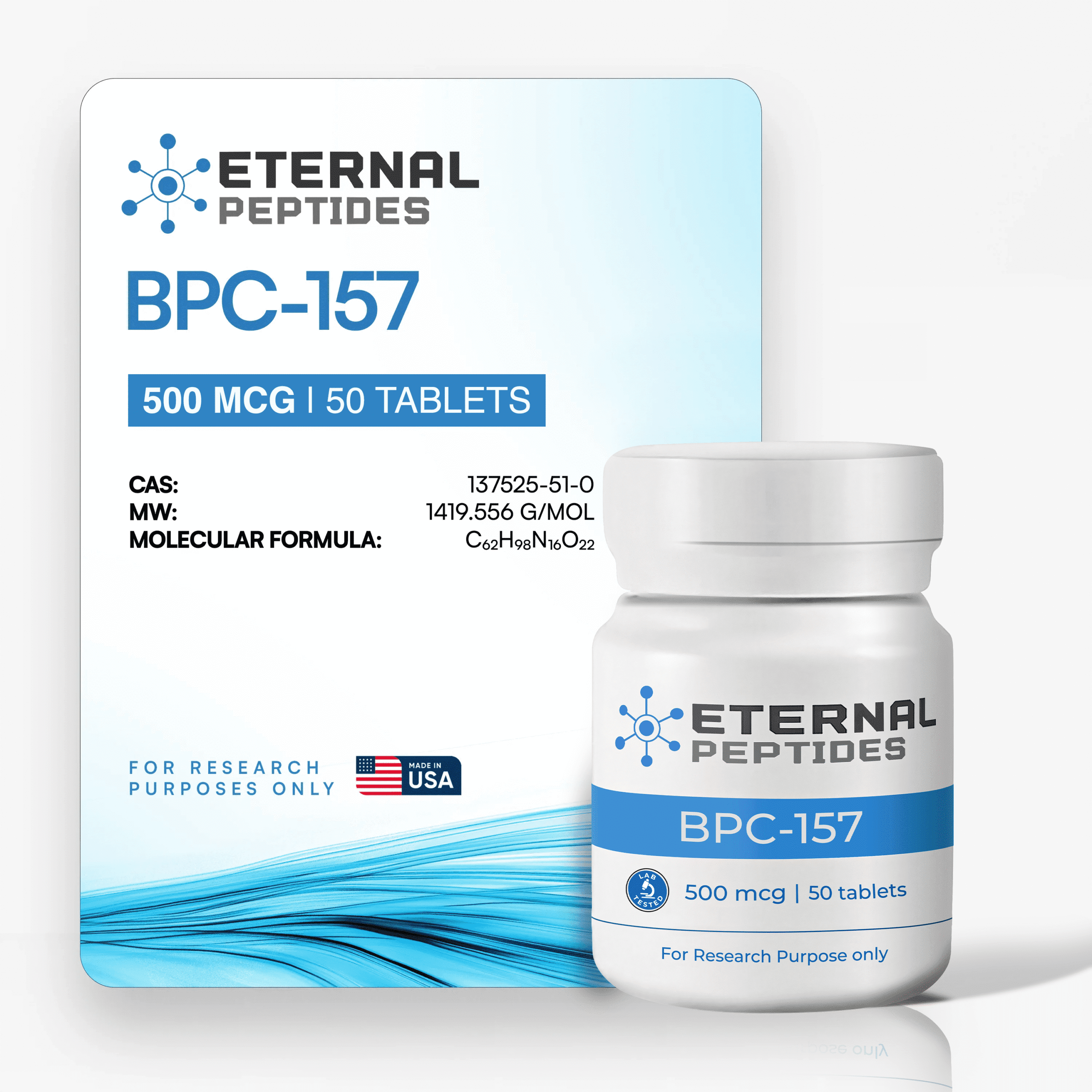
Shop high-purity 500 mcg BPC 157 tablets at Eternal Peptides, the industry leader in verified quality and experimental consistency. Our BPC 157 is synthesized to a standard of ≥99% purity, with every batch supported by independent third-party COAs (Janoshik) to ensure reliable laboratory results. We provide full traceability for individual and bulk purchases, backed by 24/7 US-based support. Order today for fast, secure shipping and free Priority delivery on all orders over $200.
BPC-157 (body protection compound-157) is a synthetic pentadecapeptide modeled after a partial sequence of a gastric protein known as BPC. It was first characterized as a stable peptide fragment present in gastric juice.
Preclinical research-largely in vitro and in rodent injury models-indicates that BPC-157 may influence multiple repair-related processes, including angiogenesis, extracellular-matrix remodeling, and cytoprotection in tendon, muscle, bone, and gastrointestinal tissues. These findings, however, are not validated in controlled human trials, and the current evidence base remains almost entirely preclinical.
As per studies and existing in the field, BPC-157 exhibits pleiotropic activity, interacting with multiple regulatory pathways rather than targeting a single receptor. These mechanistic insights come predominantly from cellular assays and animal studies.
Studies indicate that BPC-157 can modulate vascular endothelial growth factor (VEGF) expression and VEGFR2 activity, stimulating Akt–eNOS pathways linked to endothelial stabilization, angiogenesis, and tissue revascularization[1].
This means BPC-157 may help blood vessels grow and repair themselves more efficiently. By promoting these vascular processes, tissues that have been damaged or are healing-such as muscles, tendons, or gut lining-may receive improved blood flow, oxygen, and nutrients. This enhanced microcirculation can support faster recovery and maintain the health of endothelial cells that line the blood vessels, which is a critical component of overall tissue repair and regeneration.
Studies suggest that BPC-157 can counteract harmful nitric oxide (NO) overproduction while supporting normal physiological NO signalling, contributing to cytoprotection in severe injury models[2].
That means BPC-157 may help maintain a healthy balance of nitric oxide in the body, which is important for blood flow, immune response, and tissue function. However, excessive NO levels can damage cells and tissues, so regulating NO may help protect cells from injury, reduce tissue stress, and support the healing of damaged muscles, tendons, or organs.
This balanced effect is especially important during severe injury, where uncontrolled NO could otherwise worsen tissue damage.
According to preclinical models, BPC-157 may affect inflammation and help remodel the extracellular matrix, which is the scaffold supporting tissues. By interacting with proteins like FAK and paxillin, it may speed up cell migration and tissue repair, helping wounds or damaged tissues recover more efficiently[3].
BPC-157 has been shown in animal studies to demonstrate regenerative properties to the lining of the stomach and intestines. It can reduce damage from ulcer-causing agents and promote mucosal repair, supporting the integrity of the gut barrier[4]. This effect may help protect digestive tissues and maintain normal gastrointestinal function.
Some preclinical studies suggest BPC-157 may have neuroprotective effects. It appears to reduce neuroinflammation and support the health of blood vessels in the brain, which may help maintain tissue function after injury or stress[5]. These findings are mostly from animal models, so clinical relevance in humans is not yet established.
BPC-157 shows a variety of research benefits, especially in studying tissue regeneration, inflammatory response, and microvascular stability.
Preclinical work shows consistent effects across models of wound healing, tendon or ligament injury, muscle damage, and GI irritation. Researchers value it because it seems to influence several systems at once – inflammation, angiogenesis, nitric oxide signalling, and ECM remodeling – giving a broader view of how these pathways interact during tissue recovery.
Rodent studies suggest BPC-157 may support capillary repair and microvascular stability[7]. This makes it useful for studying how blood flow changes affect healing, especially in ischemic or mechanically stressed tissues.
Early research focused on the GI tract, where BPC-157 repeatedly showed protective effects against ulceration and toxin-induced damage[7]. As a result, it’s often used to explore how the gut lining maintains barrier function under stress.
Some studies highlight tissue improvements distant from the injury site, which has led researchers to use BPC-157 as a model for investigating whole-body healing responses rather than isolated, single-tissue effects.
| Property | Detail |
| Name | BPC-157 (stable gastric pentadecapeptide) |
| Sequence | Gly-Glu-Pro-Pro-Pro-Gly-Lys-Pro-Ala-Asp-Asp-Ala-Gly-Leu-Val |
| Molecular weight | ~1.4 kDa (varies slightly by salt form; confirm via COA). |
| Formats | Available as:
BPC 157 5mg lyophilized powder |
| Purity | At least 99%; verify via lot-specific COA. |
| Solubility | Lyophilized powder soluble in bacteriostatics water or appropriate research buffers; BPC 157 tablet forms are intended for controlled laboratory dissolution. |
The primary differences between the lyophilized powder and oral forms of BPC-157 relate to delivery, stability, and experimental control rather than mechanism. Lyophilized powder is typically favored in laboratory settings because it allows precise reconstitution, flexible concentration ranges, and greater control over experimental variables.
On the other hand, the tablets introduce additional considerations such as excipients, fixed dosing, and altered exposure dynamics, which may influence how the peptide is studied but do not represent a distinct or enhanced mechanism of action.
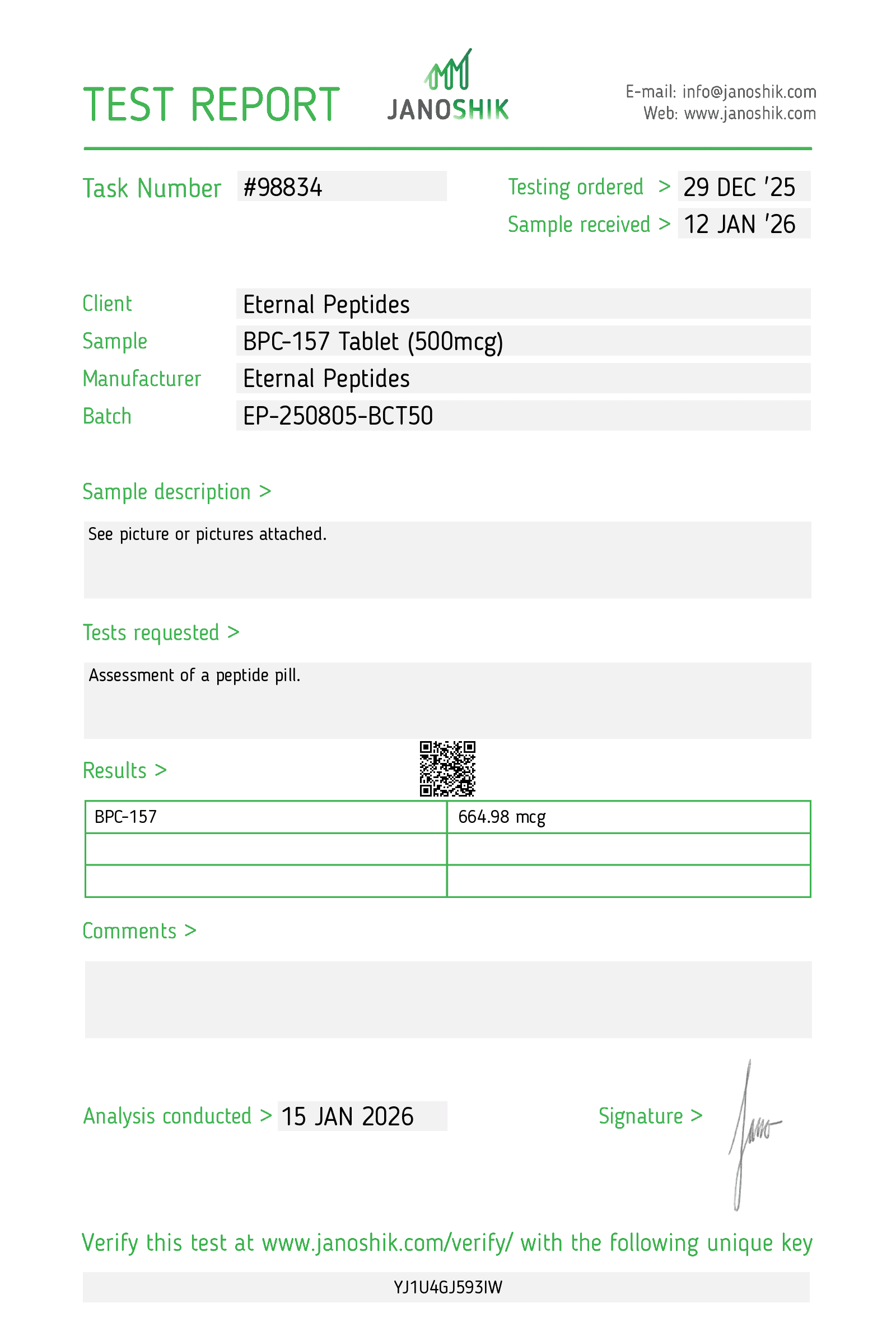
Eternal Peptides makes certificates of analysis available for every product batch. Each COA typically documents peptide identity (HPLC and/or mass spectrometry), purity analysis, endotoxin levels, sterility testing (where applicable), and specific storage recommendations for that batch.
As a reputable peptide supplier, Eternal Peptides works with Janoshik and other leading testing labs for results you can trust.
You can check that the COA corresponds to the exact lot you ordered, since Eternal Peptides keeps these records on our Lab Tests page to promote transparency, traceability, and compliance requirements.
BPC-157 from Eternal Peptides is sold exclusively for research purposes and not for human or veterinary use, clinical administration, or therapeutic applications. The compound is not approved by any regulatory authority, and its safety or effectiveness in humans has not been established.
As the buyer, you are responsible for ensuring compliance with all local laws, institutional biosafety policies, and research-use regulations. Any misrepresentation of intended use may lead to regulatory or legal consequences.
https://pmc.ncbi.nlm.nih.gov/articles/PMC7555539/
https://pmc.ncbi.nlm.nih.gov/articles/PMC12567428/
https://pmc.ncbi.nlm.nih.gov/articles/PMC11426299/
https://pmc.ncbi.nlm.nih.gov/articles/PMC7096228/
https://pmc.ncbi.nlm.nih.gov/articles/PMC8504390/
https://pmc.ncbi.nlm.nih.gov/articles/PMC12446177/
About the Author:
Dr. Sony Sherpa, MBBS, MD
is a board-certified clinician with a background in emergency medicine and clinical practice. She specializes in medical research analysis, ensuring that product information is grounded in evidence-based medicine and strictly adheres to the latest scientific standards in peptide research and recovery.