

All products are handled with strict quality standards to ensure consistent research-grade excellence.
Our checkout is SSL encrypted and completely secure.
Our products are verified by independent third party laboratories to meet quality standards.
All product batches and lots are assigned unique identifiers and tied to publicly posted lab reports.
We are committed to helping our customers. If you have any questions or concerns, please reach out through our Contact Us page.
$60.00 Original price was: $60.00.$54.99Current price is: $54.99.
| Quantity | Discount | Price |
|---|---|---|
| 5 - 10 | 5% | $52.24 |
| 11 - 20 | 10% | $49.49 |
| 21+ | 15% | $46.74 |
Every batch of our research chemicals and peptides undergoes third-party testing.
*Disclaimer: This product is intended solely for laboratory research purposes. It is not suitable for consumption by humans, nor for medical, veterinary, or household purposes. Kindly review our Terms & Conditions before making a purchase.

At every step, we prioritize quality by conducting rigorous third-party testing on all our products. These tests focus on five key characteristics- identity, purity, sterility, and endotoxin levels, and heavy metal content-ensuring that each product meets the highest standards of quality with independent third-party Certificates of Analysis (COAS) to verify our commitment to excellence.
*Disclaimer: This product is intended solely for laboratory research purposes. It is not suitable for consumption by humans, nor for medical, veterinary, or household purposes.Kindly review our Terms & Conditions before making a purchase.
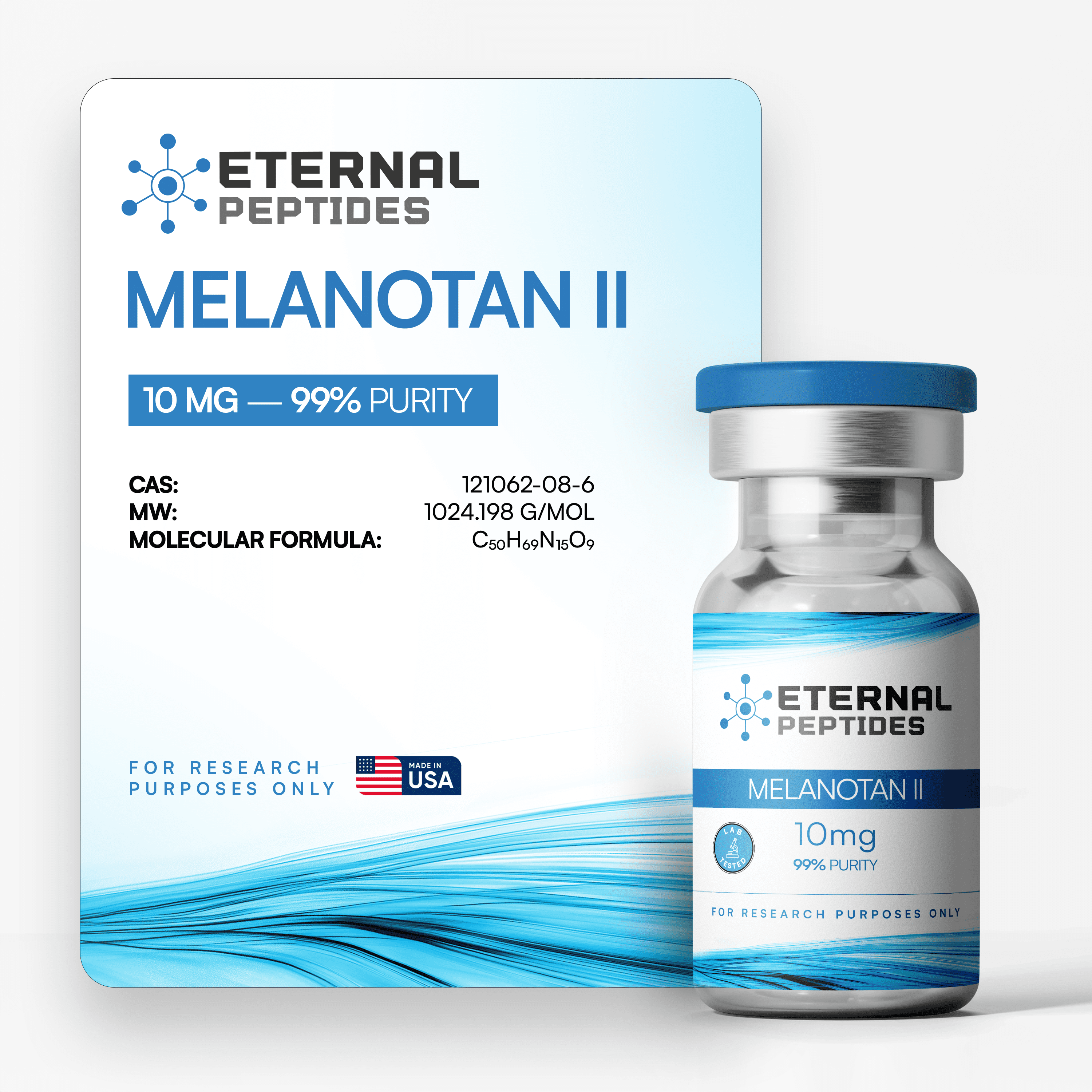
Shop Melanotan II 10mg from Eternal Peptides, a trusted supplier of research compounds known for rigorous purity and quality testing across every batch. Melanotan II is a synthetic melanocortin analog studied for its interactions with melanocortin receptors involved in pigmentation signaling and related neuroendocrine pathways. Each 10mg lyophilized unit is independently verified by third-party labs and supplied with a Certificate of Analysis for full batch transparency. Competitively priced with fast, secure USPS shipping – free on orders over $200. Sold for research use only.
Melanotan II (MT-II) is a synthetic cyclic heptapeptide analogue of α-melanocyte-stimulating hormone (α-MSH), an endogenous peptide hormone derived from proopiomelanocortin (POMC) that plays a central role in melanocortin receptor signaling.
Melanotan II was originally developed at the University of Arizona as part of a broader research program aimed at creating metabolically stable melanocortin analogues with improved receptor affinity and prolonged biological activity relative to native α-MSH[1]. Its structural cyclization and sequence modification, including the incorporation of a cyclic lactam bridge and substitution of key amino acid residues, confer resistance to enzymatic degradation and enhance binding characteristics across melanocortin receptor subtypes, making it a useful pharmacological tool for controlled laboratory investigation.
Melanotan II is structurally related to PT-141 (bremelanotide), which was itself derived from MT-II through further structural refinement aimed at improving selectivity and reducing unwanted peripheral activity. This lineage positions MT-II within a broader family of synthetic melanocortin ligands that have contributed significantly to the characterization of melanocortin receptor pharmacology.
In the scientific literature, Melanotan II is primarily studied for its broad activity across the melanocortin receptor family (MC1R–MC5R). Research has examined pigmentation pathways mediated by MC1R activation in melanocyte models, central neuroendocrine signaling via MC3R and MC4R in hypothalamic circuits, and appetite and energy homeostasis regulation in preclinical behavioral assays.
Melanotan II’s non-selective binding profile across multiple receptor subtypes makes it a useful tool for studying the melanocortin system as a whole, though this same characteristic necessitates careful experimental design when receptor subtype-specific conclusions are sought. Additional preclinical research has explored MC4R-mediated autonomic signaling, with observed effects on cardiovascular parameters and sympathetic tone in animal models, which is relevant to its pharmacological characterization and experimental handling considerations.
Much of the foundational mechanistic data on Melanotan II derives from in vitro receptor-binding studies and animal models. Human research involving MT-II has been conducted only in carefully controlled early-phase settings, contributing pharmacokinetic and receptor-level data to the broader preclinical literature, but not enough to constitute established clinical evidence or support conclusions about therapeutic application. All findings should therefore be interpreted within a preclinical research context.
This 10mg lyophilized formulation is independently verified by third-party labs and supplied with a Certificate of Analysis for full batch transparency. The lyophilized format enhances chemical stability during storage and transport, allowing precise reconstitution with an appropriate sterile solvent prior to experimental application. Under standard research conditions, reconstituted MT-II is suitable for receptor-binding assays, signaling pathway studies, and a range of preclinical research applications. Intended for research use only.
Melanotan II (MT-II) is a nonselective melanocortin receptor agonist, a synthetic cyclic analogue of α-MSH that primarily signals through GPCR-driven pathways. In research models, its main mechanistic theme is melanocortin receptor activation (MC1R–MC5R), leading to downstream second-messenger signaling that can shift pigmentation biology in peripheral tissues and neuroendocrine outputs in the CNS.
Reported outcomes in the literature include increased melanogenesis in melanocyte systems, reduced food intake/weight signals in rodent models, and centrally mediated sexual arousal effects. These observations are often discussed alongside classic MT-II experiments and follow-on work that helped motivate derivatives such as PT-141 (bremelanotide).
MT-II binds melanocortin receptors (notably MC1R, MC3R, MC4R, and MC5R) and initiates canonical GPCR signaling, most commonly described as adenylyl cyclase → cAMP → PKA-mediated transcriptional and enzymatic changes, with additional pathway “branching” depending on receptor subtype and cell context[2].
This receptor-level pharmacology is why MT-II is used as a tool compound in receptor-binding assays, second-messenger readouts, and pathway-mapping experiments. In practical research terms, investigators use MT-II to probe how melanocortin activation reshapes cellular outputs (e.g., pigment-related enzymes in melanocytes) or network-level outputs (e.g., appetite circuitry readouts in rodents), but this doesn’t imply therapeutic intent in any context.
In melanocyte and skin-model research, MT-II is most often framed around MC1R activation, which biases signaling toward increased eumelanin-associated pathways and melanogenic activity[3]. That shows up experimentally as changes in pigment production markers, melanocyte functional responses, and UV-response modeling, which is one reason MT-II has been repeatedly discussed in the context of “sunless tanning” mechanisms in the scientific and clinical review literature.
From a laboratory perspective, this provides a controllable way to stimulate melanocortin signaling and observe downstream pigmentation biology in vitro and in animal studies, including how timing, dose, and receptor expression levels influence the magnitude and persistence of pigment-related readouts.
Because MT-II can act within the CNS in experimental settings, it has been widely used to interrogate MC3R/MC4R-dependent neuroendocrine and behavioral endpoints. Classic rodent work using central (e.g., intracerebroventricular) administration is often cited for acute suppression of feeding and related energy-balance signaling, and some studies have linked central MT-II exposure to metabolic readouts such as insulin sensitivity under controlled experimental conditions[4].
Separately, melanocortin agonism has also been explored in models of sexual arousal/erectile response, helping clarify a centrally mediated melanocortinergic contribution that later informed development programs for related agonists[5].
Most mechanistic understanding of Melanotan II comes from in vitro assays, receptor pharmacology, and animal/rodent models, including studies that use non-physiologic routes of administration to isolate CNS mechanisms. Controlled human clinical evidence for MT-II itself is limited, and findings should be interpreted as preclinical, model-dependent observations rather than established clinical effects.
Preclinical research has examined Melanotan II primarily in pigmentation biology, central melanocortin signaling, appetite regulation models, and sexual behavior studies. These observations derive largely from in vitro systems and animal experiments and do not establish human or veterinary benefits.
Melanotan II is not approved for therapeutic use. Eternal Peptides supplies this compound strictly for laboratory research use, and no clinical claims are made or implied here.
Melanotan II is widely studied for its ability to stimulate melanocortin-1 receptor (MC1R) activity in melanocytes, leading to increased cyclic AMP signaling and upregulation of melanogenic enzymes such as tyrosinase[3].
In cell cultures and animal models, this signaling cascade is associated with increased eumelanin production and measurable changes in skin pigmentation. Some early human research explored pigmentation responses under controlled conditions, but the majority of mechanistic data comes from laboratory models.
In simple terms, researchers use Melanotan II to “switch on” pigment-producing pathways in laboratory experimental systems to observe how melanocytes respond.
Central administration studies in rodents have shown that Melanotan II can activate melanocortin-4 receptors (MC4R) in the hypothalamus, resulting in reduced food intake and altered energy expenditure markers[6]. These experiments are often conducted via intracerebroventricular routes to isolate central signaling pathways.
Observed effects typically include acute appetite suppression and transient body weight changes in controlled animal settings. Put plainly, scientists use Melanotan II to study how melanocortin pathways influence hunger and metabolic signaling in the brain of research animals.
Melanotan II has also been investigated in animal models for its effects on central melanocortin circuits involved in sexual behavior[7]. Research in rodents has demonstrated pro-erectile responses and changes in sexual arousal behaviors following central or systemic exposure.
These findings have contributed to broader interest in melanocortin receptor pharmacology and informed later development of more selective analogues. In short, researchers use Melanotan II to examine how melanocortin receptor activation influences neuroendocrine signaling related to sexual function in animal models.
Some rodent studies suggest melanocortin receptor activation by Melanotan II may influence glucose regulation and insulin sensitivity under specific experimental conditions[8]. These observations are typically secondary outcomes in appetite and energy-balance research rather than primary endpoints, and these effects vary by model, dosing strategy, and route of administration.
In other words, Melanotan II is sometimes used in metabolic research to observe how melanocortin signaling interacts with broader energy and glucose control systems in laboratory animals.
| Property | Description |
| Name | Melanotan II (MT-II); synthetic cyclic heptapeptide analogue of α-melanocyte-stimulating hormone (α-MSH) |
| Sequence | Ac-Nle-c[Asp-His-D-Phe-Arg-Trp-Lys]-NH₂ |
| Molecular Weight | 1024.2 g/mol |
| Molecular Formula | C₅₀H₆₉N₁₅O₉ |
| PubChem CID | 92432 |
| Structural Class | Cyclic lactam peptide; melanocortin receptor agonist |
| Product Form | Lyophilized powder supplied in 10 mg research vials |
| Purity | Typically ≥99%, verified with Certificate of Analysis (COA) |
| Solubility | Soluble in bacteriostatic water or sterile laboratory-grade aqueous solutions following reconstitution; handle under controlled laboratory conditions |
| Stability | Lyophilized form supports extended storage under refrigerated or frozen conditions; reconstituted solutions require cold storage and limited-use timeframe |
Note: Melanotan II is supplied in lyophilized format to support transport stability and precise laboratory reconstitution. Structural cyclization enhances resistance to enzymatic degradation compared to linear α-MSH analogues.
Proper handling of Melanotan II is essential to preserve structural integrity and ensure consistent experimental results. As a cyclic peptide supplied in lyophilized form, it should be protected from environmental stressors that may accelerate degradation.
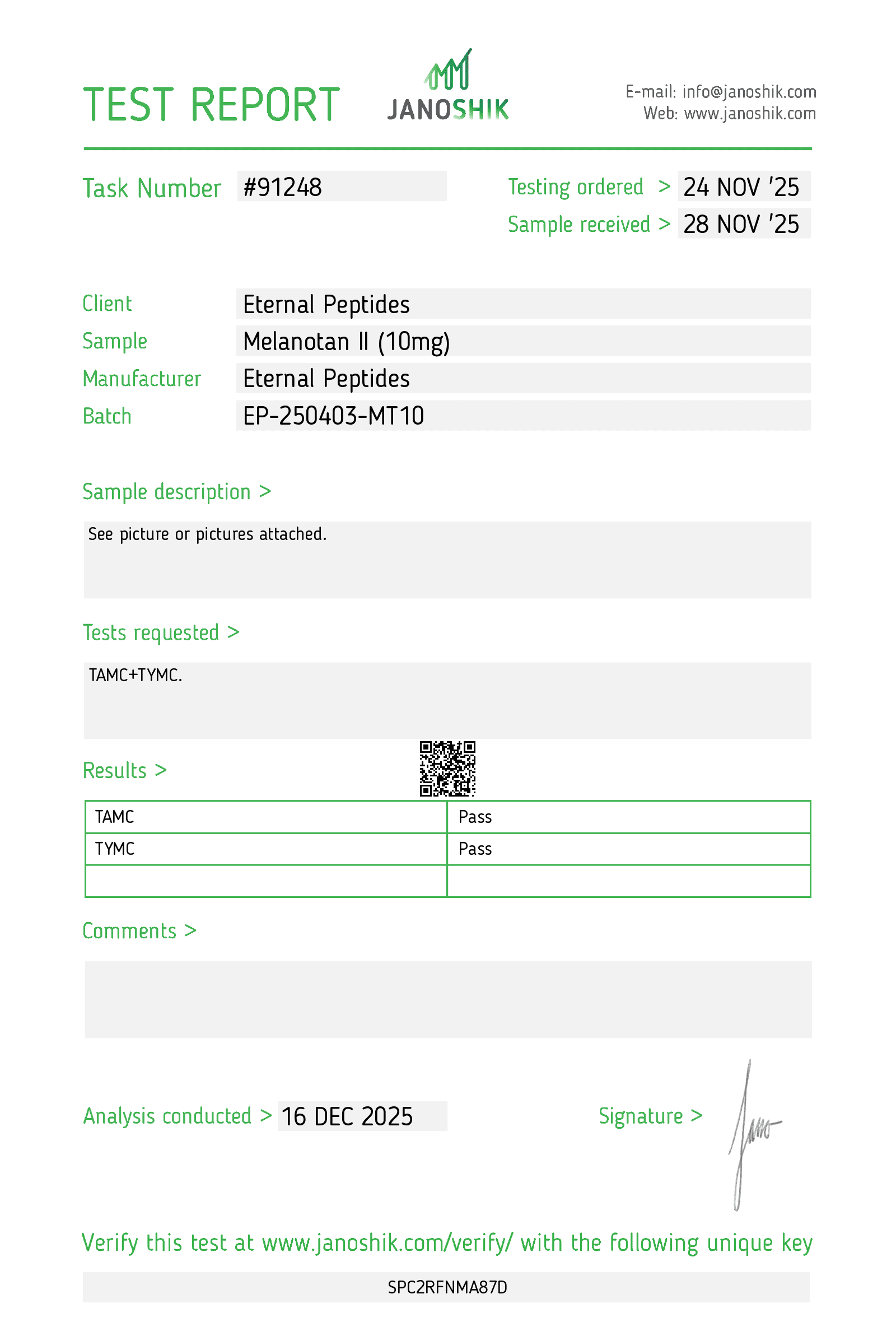
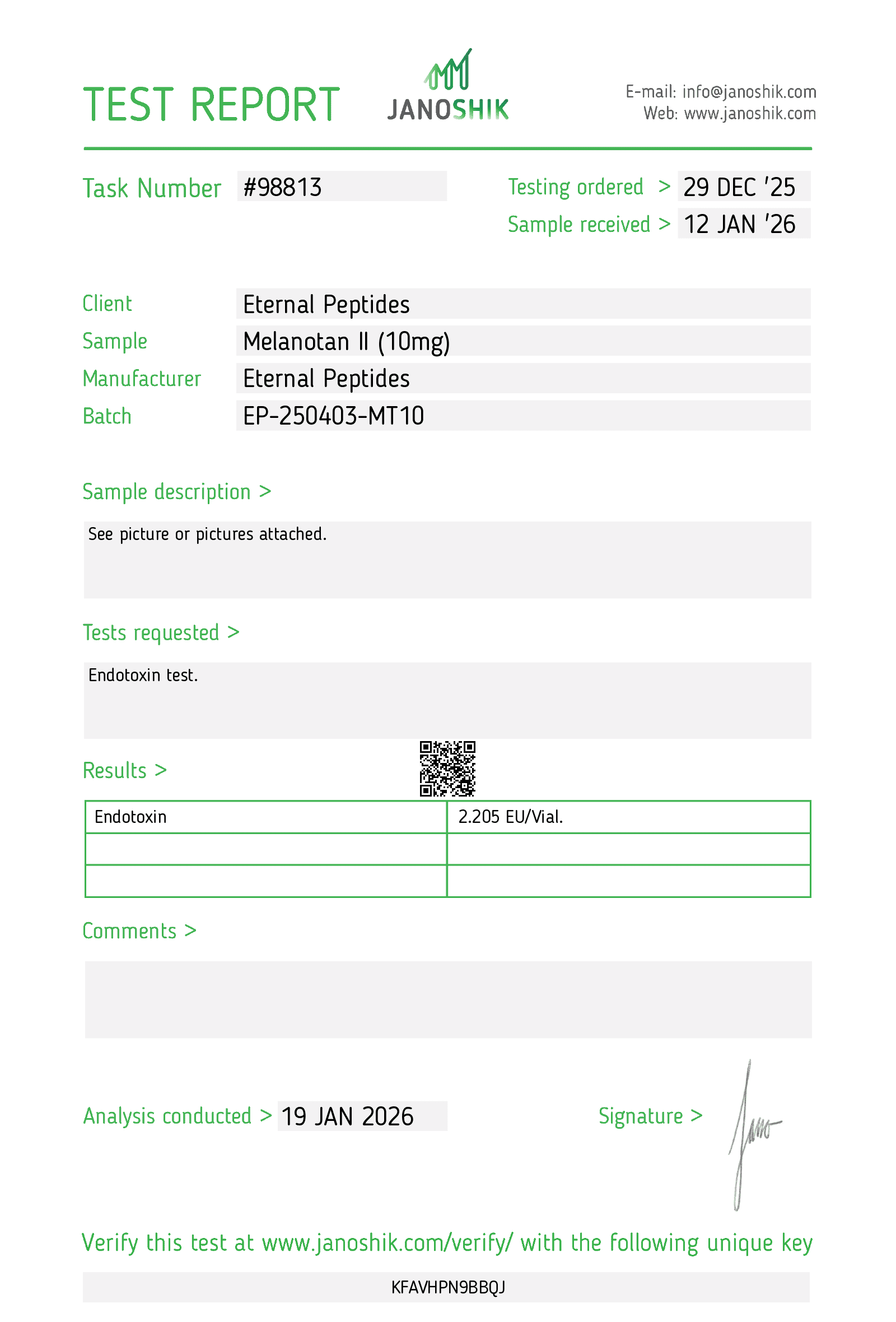
Each lot of Melanotan II is accompanied by a lot-specific Certificate of Analysis (COA) to support research transparency, traceability, and reproducibility. Eternal Peptides maintains documented quality control standards and partners with independent third-party laboratories, including Janoshik, to provide objective analytical verification.
COAs are generated for every production batch and typically include:
All COAs are lot-specific, traceable, and accessible through our Lab Tests page, allowing researchers to confirm batch data for documentation, audit compliance, and experimental consistency.
Melanotan II is supplied strictly for laboratory research use only. It is not approved for human or veterinary use, clinical administration, therapeutic application, or diagnostic procedures of any kind. Safety, efficacy, and appropriate dosing in humans or animals have not been established.
Purchasers are responsible for ensuring compliance with all applicable local, state, and federal regulations, as well as institutional biosafety policies governing research chemicals. This material must be handled exclusively by qualified professionals within controlled laboratory environments. Any misrepresentation of intended use or diversion for unauthorized purposes may result in regulatory action or legal consequences.
About the Author:
Dr. Sony Sherpa, MBBS, MD
is a board-certified clinician with a background in emergency medicine and clinical practice. She specializes in medical research analysis, ensuring that product information is grounded in evidence-based medicine and strictly adheres to the latest scientific standards in peptide research and recovery.